 |
 |
 |
Napoleon BonaparteEmperor of France By Richard Moore 12
Portraits of Napoleon Bonaparte
Not a Frenchman by birth, Napoleon Bonaparte was born at Ajaccio on Corsica - only just sold to France by the Italian state of Genoa - on 15 August 1769 and learnt French at the school of Autun and later the military academy at Brienne. He never fully mastered French and his spelling left a lot to be desired. The revolutionary fever that was spreading when Bonaparte was a teenager allowed a talented individual the opportunity to rise far beyond what could have been achieved only a few years previously. His first real military opportunity came as a captain of artillery at the siege of Toulon, where he expertly seized crucial forts and was able to bombard the British naval and land forces, eventually forcing them to sail away. Now a brigadier-general, Bonaparte served in the army campaigning in Italy but found himself arrested and jailed for being an associate of the younger brother of Maximilien Robespierre. With no position for him after his release, Bonaparte thought about joining the Turkish army and even joining a naval expedition to Australia, but became involved with a member of the Directory, Paul Barras, who used the young man's zeal to put down a royalist mob in 1795 with the now legendary "whiff of grapeshot". With his loyalty and ruthlessness proven, the next year Bonaparte took up command of the Army of Italy and set off on a campaign that was to take him to absolute power in France and Europe. Initially treated with suspicion, and not a little contempt, by the older generals he superceded, Bonaparte won over his badly treated soldiers with promises of great things to come and a large helping of personal bravery. Like Caesar, he was not afraid to get into the thick of the fighting to inspire his men. In a series of battles that included such as Montenotte, Mondovi, Arcola and Rivoli, Bonaparte swept the board of ageing Austrian generals and established himself as one of the leading soldiers of his time. After masterminding the Peace of Campo Formio, Bonaparte returned to Paris where he took command of the Army of England, an imposing force neutered by England's wooden walls of its navy. Desperate to be both at Britain and pushing his own reputation, Bonaparte planned an expedition to Egypt to threaten his foe's trading routes. He sailed from Toulon in 1798 and, after capturing Malta, made it to Egypt in early July. The campaign began brilliantly when he smashed the power of the ruling Mamelukes at the Battle of the Pyramids, but was crippled when Nelson's hound-pack fleet finally caught up with the French navy at Aboukir (Battle of the Nile) and sank all but four of the 17-ship force. Stranded and with suspect supply lines, Bonaparte moved into Syria and won the battle of Mt Tabor before being halted by fierce and stubborn resistance at Acre. Stricken with disease and wary of a mass revolt in Cairo, the French made a horrendous march through the deserts of the Sinai, but arrived at Aboukir in good enough condition to crush another Turkish force. Realising the potential success of his campaign was now limited, if not impossible, Bonaparte decided to abandon his army and get back to the centre of power - Paris - and make sure his position had not been undermined. Popular with the people, Bonaparte found the loathed Directory very cool towards his surprise arrival and no doubt took pleasure in their discomfort when he, Abbe Sieyes and Roger Ducos seized power in the Coup de Brumaire, which saw them share power as equal consuls. Within months Bonaparte was First Consul and had eased his "equals" into early retirement. The next stage in Bonaparte's career came in 1800, when he again moved into Italy with another brilliant manouevre that saw him lead the French army over the Alps and surprise the occupying Austrians. It almost proved to be a blunder - as Bonaparte was in turn caught by surprise at the tenacity of General Melas who attacked him at Marengo. Holding on for grim life the situation was saved for Bonaparte by General Louis Desaix's arrival with reinforcements and what was a lost battle became a stunning victory for the First Consul. Together with the victory at Hohenlinden, Marengo forced the Austrians to the table and the resulting Peace of Leoben in 1801 and Peace of Amiens (1802) brought to an end a decade of revolution, strife and war. He also got France back in to the good books of Rome through the Concordat with the Pope, which eased the restrictions and penalties imposed on the church by the Revolution. Bonaparte's popularity was now unprecedented and he was voted Consul for life. Setting about much-needed civil reforms he turned upside down the old system of running France and introduced the Civil Code. But all was not safe for Bonaparte and there were several attempts on his life, including a bomb set off in Paris as his carriage went by. Still, in 1804, the general felt confident and secure enough to declare himself Emperor and the next day created the Marshalate for his most trusted and talented soldiers. Bonaparte waited until 2 December for his coronation where, with much pomp and ceremony, he crowned himself. While affairs within France were on a high, Bonaparte committed a serious error when the determined Duc d'Enghien, a Royalist figurehead, was kidnapped from neutral Baden, tried without a lawyer defending him and then executed. The event turned Europe's monarchies forever against him and led to the formation of the Third Coalition to try to bring down his regime. Bonaparte reacted by amassing a huge army - the first Grande Armee - on the coastline of Europe with the intention of invading Britain but, fortunately for those opposing him, he was never given the opportunity as Admiral Horatio Nelson smashed his naval ambitions at Trafalgar in 1805. While his political radar may have been off with the D'Enghien affair, his military one was not and knowing his enemies were mobilising against him he prepared a pre-emptive strike. Secretly redeploying the 200,000-man Grand Armee, Bonaparte had them march by various routes until they were in striking distance of Austria's General Mack, who was waiting at Ulm for the arrival of the Russian army under General Kutusov. The French manouevre worked brilliantly and General Mack found himself trapped within the city of Ulm with little sign of Kutusov. He made two major attempts to extricate his 27,000 men - at Elchingen and Haslach - but in the end had little choice but to surrender. With the way to Vienna clear, Bonaparte occupied the enemy capital and then set out after the Russians and the remaining Austrian forces. He caught them at Austerlitz where, with tactical brilliance, he tricked them in to attacking him and proceeded to destroy them. The victory led to the Peace of Pressburg and Austria was forced to give up huge areas of influence in Germany and Italy. With Europe pacified, the French emperor once again turned his eyes towards Britain and developed a plan to wage economic war - the Continental System - on his closest enemy. With the large number of states under either his control or influence, Bonaparte decided that by excluding Britain from trading with them he could hurt that nation's economy sufficiently to stop it bankrolling more wars on mainland Europe. Reluctantly adopted by Europe, it didn't take long for the Continental System to begin another war. In order to stop Portugal trading with Britain he sent an army through his ally Spain to enforce the blockade. Then, inexplicably, he used the presence of French troops in Spain to persuade the King Charles IV to step down and be replaced by Joseph Bonaparte. The reaction of the Spanish people could have been predicted and an uprising broke out that was to spread across the entire nation and last for six years. Bonaparte's miscalculation was to cost him more than 200,000 casualties and be a constant drain upon his resources. It was aptly dubbed "the Spanish Ulcer". Worse was to come as a French army was forced to surrender to a Spanish force at Bailen, destroying the notion of French invincibility, and Britain landed a small army under Arthur Wellesley in Portugal. It quickly defeated General Junot's Army of Portugal and forced Bonaparte to return to the field at the head of a hastily assembled force. His campaign was highly successful, defeating the Spanish and putting down the major revolt and he managed to force the British, now under Sir John Moore, into a scrambling retreat to Corunna and evacuation by ship. Bonaparte's success, however, failed to impress the Austrians and, by 1809, the leaders in Vienna felt confident enough to form the Fifth Coalition with Britain and move against France's Bavarian allies. Caught by surprise the French, under Marshal Berthier, initially were in serious trouble against the capable Archduke Charles, but the arrival of the emperor bolstered confidence and began to set things to rights. The French won the battles of Abensberg and Eckmuhl, almost lost Aspern-Essling after Bonaparte's advanced units became trapped against the flooded Danube River with the entire Austrian army bearing down on them, and then defeated Charles at Wagram. Peace followed and was cemented when Bonaparte, now divorced from Josephine, married Marie-Louise of Austria. Between 1810 and 1812 tensions between France and Russia kept increasing and, when Tsar Alexander refused to back down despite an army of 600,000 men on his border, Bonaparte ordered an invasion. Despite being well planned the campaign was doomed by the sheer distances that had to be marched. Bonaparte was hoping to force a decisive battle soon after entering Russia, but the defenders traded space for time by reteating. There were bloody, but indecisive, battles at Smolensk and Borodino and, when the French finally reached Moscow, they found that the Russians had preferred to set fire to it rather than let the French have it.
Still hoping for peace negotiations, Bonaparte delayed leaving the capital for too long and on his march back to France disaster hit the Grande Armee. Appalling cold, lack of supplies and constant attacks by Russian forces whittled away the once-magnificent army so that when it finally stumbled out of Russia its survivors numbered fewer than 20,000. Seeing the French almost on their knees the revenge-seeking Prussians broke their alliance with Paris and, together with Sweden, joined the Tsar's campaign to kick the French out of Germany. The 1813 Campaign through Germany saw a weakened Bonaparte fight and win the battles of Lutzen, Bautzen and Dresden, but the sheer weight of numbers caught up with him at Leipzig, where some 200,000 Frenchmen took on 400,000 enemy troops in a massive three-day battle. Defeated, and his forces also facing an unbeaten and advancing British army in Spain, Bonaparte gathered strength for his last roll of the die - the battle for France. The following campaign saw Bonaparte return to his brilliant best and he won battle after battle with weak and inexperienced forces pitted against seasoned and seemingly innumerable enemies. Finally, however, the numbers told and he was forced to abdicate by his marshals on 6 April 1814. He gave a final farewell to his Old Guard at Fontainbleau on 20 April and chose 600 men to go into exile with him on Elba. On the island Bonaparte plotted his return and taking advantage of lax security and in the knowledge there was a growing resentment of the restored Bourbons and Louis XVIII, he landed in France in early March of 1815. Despite being branded an Enemy of Humanity by his enemies, the French people flocked to him and within months he had rebuilt his army for the expected arrival of the armies of Russia, Prussia, Austria, Sweden and Britain. Rather than wait he launched a lightning campaign into Belgium in the hope of catching the British, under the Duke of Wellington, and the Prussians, under Field Marshal Blucher, off guard. The plan worked, but a series of command errors by subordinates blew the opportunities offered and despite victory at Ligny and a tactical draw at Quatre Bras, he was defeated at Waterloo. Exiled a second time, the man who ruled Europe spent his last six years on a small island in the South Atlantic called St Helena. His death in 1821 brought relief to the royal houses of Europe and it was only in 1840 that his body was allowed to return to his beloved France.
|
||
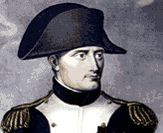 One
of the most brilliant individuals in history, Napoleon Bonaparte
was a masterful soldier, an unequalled grand tactician and a superb
administrator. He was also utterly ruthless, a dictator and, later
in his career, thought he could do no wrong.
One
of the most brilliant individuals in history, Napoleon Bonaparte
was a masterful soldier, an unequalled grand tactician and a superb
administrator. He was also utterly ruthless, a dictator and, later
in his career, thought he could do no wrong.
|
Napoleon
Bonaparte
|
|
| Career | Portraits |
| Quotes | Family |
| Loves | Letters |
| Plots | Murdered? |
| His will | Places |
|
Era
of Napoleon
|
|
| Powers | Opponents |
| Coalitions | Allies |
| People | Timelines |
| Key sites | Shrapnel |
|
Warfare
|
|
| Campaigns | Battles |
| Armies | Generals |
| Marshals | Winners |
| Glossary | Medical |
| Weapons | 1812 War |
| Uniforms | Battlefields |
|
War
at Sea
|
|
| Naval War | Heroes |
| Artworks | Signals |
| Nelson | Trafalgar |
|
Maps
|
|
| Key Maps | Peninsula |
| Animated | 1796/1800 |
| 1809 | Russia |
|
French
Revolution
|
|
| Revolution | Guillotine |
| Posters | People |
|
Art,
Film, Games
|
|
| Education | Goya |
| Sharpe | Hornblower |
| Books | Movies |
| DVDs | Music |
| Wargames | Images |
| Cartoons | Caricatures |
|
Other
|
|
| About Us | Sources |
| Awards | Sitemap |
| Links | Militaria |
| Miniatures | Reenactors |
| Forum | Quizzes |
| Home | Waterloo Diorama |
|
Napoleonic
Auctions
|
|
| General | Miniatures |
| Militaria | |